Spoilers don’t die, they multiply.
I’ve been waiting on this one to become available online for a while. From what I have managed to catch, I could recognize the familiar man vs. machine theme updated to the AI conversation that trends in all our conversations both online and off. To be honest, I wanted a more updated and nuanced treatment than just plain tolerance or intolerance. The film does mix AI with sentience, a common popular belief of the progression of simulation. I have a few thoughts on that.

The Creator (2023) is directed by Gareth Edwards who came up with the story and wrote the screenplay with Chris Weitz. After a major disaster is blamed on AI error, the west condemns and bans all AI life while the east embraces it. In the midst of this war, Joshua (John David Washington), a soldier from the US still mourns the death of his wife Maya (Gemma Chan) whom he met while living undercover. He is drafted again by the Army in a mission to steal a secret AI weapon, agreeing only to join them when he learns the possibility that she might still be alive and involved. Once he finally gets to the weapon, he’s baffled to learn it’s an AI child. The little girl, who Joshua nicknames “Alfie”, will be sought after by both sides. On the US Army side, they are being pursued by Colonel Howell (Allison Janney) while the AI resistance is led by Harun (Ken Watanabe).
The subject of AI becoming the road to sentience and hence actual individual thought has been long considered in movie universes as rooted in evolution. As much as each achievement in AI is illustrating the capacity and potential for further progress, it’s always been more fantastic than scientific to believe that sentience can be achieved that way. Every change requires a lot of energy. The rules and regulations that we need to put in place are not there to save us from “machines taking over”. It’s not about accidental sentience, it’s about putting too much trust and giving too much power to something only capable of simulating intelligence without having moral and humanity to restraint it. It’s not about accidentally creating life, it’s about trusting AI with human lives and provoking an accident. Every AI is limited by their very human design, input and feedback. I could so much write a TED talk on this subject alone.
The suspension of disbelief in this case, which is not an original take but rather a common cinematic theme, is that the topic would result into only two viewpoints: one for the AI and one against it. It’s a lie and the movie knows it. For the Asian nations, we see AI working as policeman, military and even religious posts. For the US, we notice they still blatantly use AI as suicide bombers, to illustrate how much the anti-AI philosophy is rooted in barbarism. There are very little nuances to either side, the US Army just kills each AI encampment regardless of how much percentage of human life exists. The AI is given a much more human aspect, even explaining how the triggering accident for the war was actually human error. In the real world, every error from AI is human error (or at least human limitation), but it’s obvious here that what we’re doing here is depicting human xenophobia in all its systematic infamy.
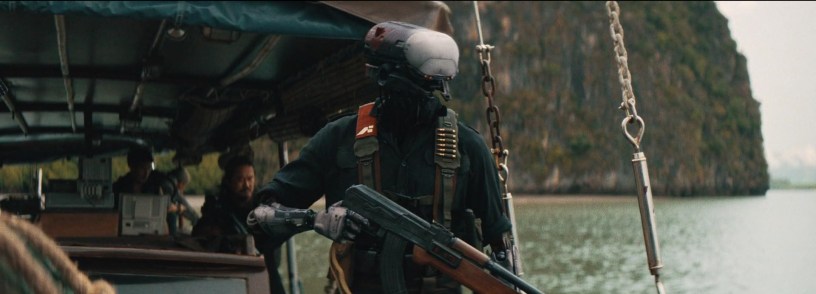
It works, which human limitations. Yes, I get this is less about AI in particular and more about how the more civilized and powerful treats those it considers beneath them. It’s the well known sci-fi metaphor for racism. I do love the world building and the design of vehicles, vessels, and AI folk in general. The story is a bit oversimplified in the way it radically sets two opposite sides instead of using a spectrum. It’s not historically inaccurate, but it’s very reductive to present this as two factions only. Despite the limited range, I was engaged with the tale and I appreciated the care in presenting all the concepts even if they were only limited to visuals. The ending decides to ramp up the stakes, which felt a bit jarring and rushed.
Highly recommended with reservations. Right now, it seems to be more of a visual CGI feast but the visual concepts of every device, AI entity, vehicle and vessel are very smoothly done. Once it ages, it might be overtaken by newer technology. The story at its heart is a mix of techno-xenophobia and racist metaphor with the obligatory anti-imperialistic take. I wish it had a more nuance take than the usual good-vs-evil-black-an-white conflict but it does get the point across. I does feel the ending is just trying to cater to a hollywood template and feels almost tacked on. Worth a watch nevertheless.
That will do for now.
 Never Think Impossible
Great post
This blog post was really interesting! I love how it explores the theme of AI and sentience. It’s always been fascinating to me to consider the possibility of AI becoming truly conscious. My question for the author is, do you think we will ever be able to achieve true AI sentience, or is it just a fantastical concept?
I concede that our AI simulations are getting better at processing information. Still, they are simulating decision-making based on algorithms limited by human-engineered programming. We instill concepts such as urgency, patience, empathy, judgement into the things we create by the decisions we think are correct. The moment we craft algorithms those concepts fade and the logic represented becomes static. We’re close to the point in which, under certain conditions and very curated information, we can simulate intelligent thought enough to fool ourselves but far from digitally engineer it. I don’t think we’re close to true sentience yet. It might be possible one day.